About Prime Numbers
Prime Numbers, i.e. numbers with no factors other than 1 and themselves, are in many ways the most important numbers of all since they cannot be simplified, cannot be broken down. They act as the building blocks for all the integers; every integer is a product of primes.
But here's the amazing part — each of these other numbers can be built from a product of primes in only one way!
Think about it. Why should this be so? Would you expect it?
For example we are perfectly happy with the fact that 84 is both 14 × 6 and 12 × 7. The numbers 6, 12 and 14 are factors of 84, but not prime factors. If we consider the prime factorisation: 84 = 2 × 2 × 3 × 7, the factors 2, 3 and 7 are all primes and there is no other way to get 84 from a product of primes. (Incidentally, this is why 1 is not considered prime; otherwise we could add any number of × 1 terms to a prime factorisation.)
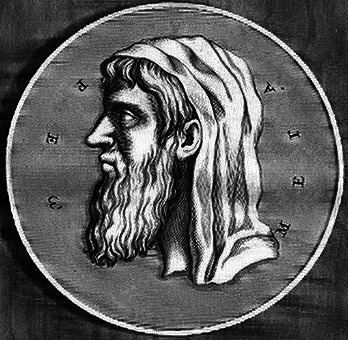 Euclid of Megara
Mathematicians are so amazed by this, think it is so cool, that they've given it a special name:
This is just a fancy way of saying "The most important property of numbers". It is a core mathematical result, proven by Euclid in 300BC.
Finding primes
Euclid also proved that there are an infinite number of primes. This proof is in his book, The Elements — the world's first maths textbook, and one that has remained in use for more than 2000 years!
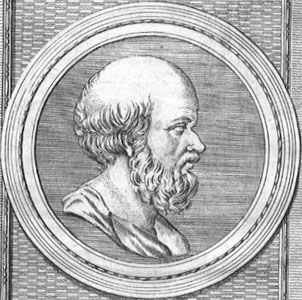 Eratosthenes
Eratosthenes, who lived from 276 to 194BC is known as the Father of Geography. He was the first to measure the circumference of the Earth, calculating it to be 46000km (the actual value is close to 40000km). He went blind in his old age, and starved himself to death.
Many properties of primes and their relationships with other integers were discovered by the Ancient Greeks (including Euclid and Eratosthenes as we've seen). However, there are still many unsolved problems regarding primes. The most famous of these is the Goldbach Conjecture from 1742 which states that every even integer greater than 2 can be written as the sum of two primes. Extensive computer searching has failed to find a counterexample, but no one has yet managed to prove the conjecture to be true.
Cracking a code
Did you know that cracking modern day secret codes like RSA and PGP is like finding the large prime factors of an even larger number? Encoding is like multiplying two large numbers — that's easy; but decoding is like finding the factors when you only have the product. If the two large numbers are primes, that is very hard unless you have the key for the encoding — even for computers. Click the following button to have a try yourself:
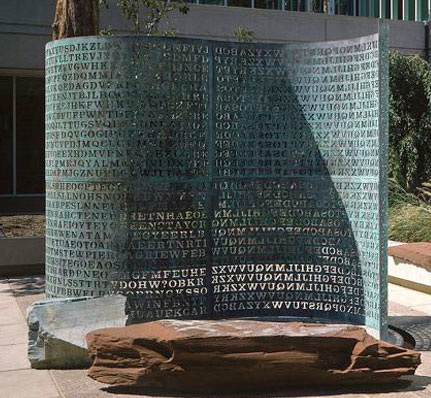 The Kryptos sculpture
(outside the CIA headquarters)
The application of prime numbers to cryptography has driven the search for large primes. Although primes have been studied since ancient times, up until the 18th century the largest known primes were only 6 digits long: 217 − 1 = 131071 and 219 − 1 = 524287. A 10 digit prime was found by Euler in 1772, and a 13 digit one in 1867. Then in 1876, Lucas found the 39 digit prime 2127 − 1 = 170141183460469231731687303715884105727.
Electronic computers have revolutionised the search for large primes, and the record in 2013 is the massive 257885161 − 1 = a 17 million digit number!.
Did you notice how these large primes are all one less than a power of 2, and the power is itself a prime number?
This form of prime number
is known as a Mersenne Prime after the early 17th century French monk Marin Mersenne.